Cleanliness Testing Solutions for Battery & Energy Storage Systems
Industry Overview: Why Component Cleanliness Matters
As battery technology and energy storage applications continue to develop, battery manufacturing is placing increasing emphasis on product consistency, operational reliability, and manufacturing quality. From lithium-ion battery cells and battery modules to battery packs and Battery Energy Storage Systems (BESS), each manufacturing stage involves materials, components, and assembly processes that require effective contamination control.
During electrode processing, component machining, module assembly, electrical connection, and thermal management system manufacturing, particulate contaminants may be introduced into products or remain on critical component surfaces. These contaminants can include metal particles, machining chips, burrs, dust, fibers, and other manufacturing residues.
Depending on their material, size, location, and electrical or mechanical characteristics, particles may create potential risks for battery manufacturing and system operation. For example, conductive metallic particles in sensitive battery manufacturing areas may increase the risk of unintended electrical contact, while machining residues inside cooling channels may restrict coolant flow or affect heat transfer performance.
For battery manufacturers and energy storage system integrators, technical cleanliness testing provides a measurable approach to identifying and evaluating particulate contamination. It supports manufacturing quality control, cleaning process validation, supplier evaluation, and continuous improvement across the battery production chain.
Applicable Battery & Energy Storage Components
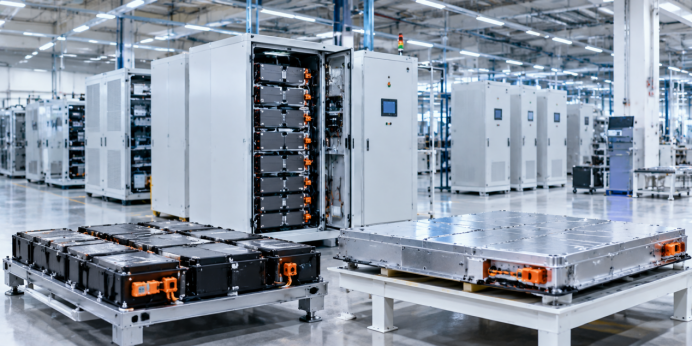
Cleanliness inspection may be required for different components throughout battery manufacturing and energy storage system production. The inspection scope should be determined according to component function, material, manufacturing process, contamination risk, and customer specifications.
Battery cell and module components
l Battery cell casings and structural components
l Battery module frames, end plates, and support brackets
l Battery pack housings and internal structural parts
l Cell-to-cell connection components and busbar assemblies
Battery thermal management components
l Battery cooling plates and liquid-cooling manifolds
l Cooling pipes, connectors, and fluid distribution components
l Heat exchanger components and cooling system housings
l Precision-machined parts used in battery thermal management systems
Electrical and power connection components
l Copper and aluminum busbars
l Electrical terminals and conductive connectors
l Power distribution components and connection housings
l Precision-machined electrical components and mounting parts
Battery Energy Storage System (BESS) components
l Battery rack structures and module enclosures
l Battery cabinet cooling components
l Liquid-cooling system pipes and connectors
l Selected power conversion and auxiliary system components
Common Sources of Particle Contamination
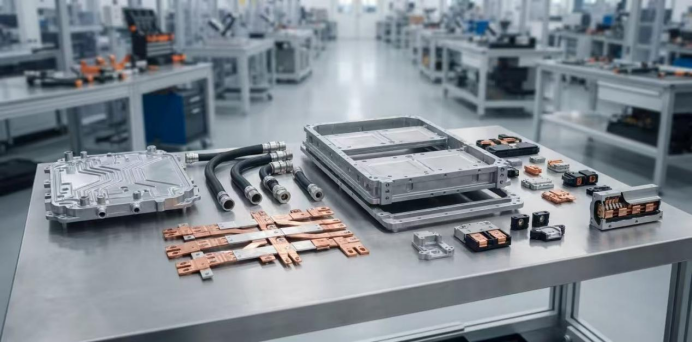
Particulate contamination can be introduced at different stages of battery and energy storage manufacturing. Understanding these sources helps manufacturers identify potential contamination risks and improve process control.
Material processing and machining: Cutting, milling, drilling, grinding, and deburring may generate metal chips, burrs, and fine machining residues. These particles may remain in mounting holes, grooves, threaded areas, and internal passages.
Electrode and battery component manufacturing: Material handling, coating-related equipment, slitting, cutting, and other production operations may introduce dust, material fragments, or equipment-related wear particles. The relevant contamination characteristics depend on the battery chemistry and manufacturing process.
Casting and forming: Aluminum and steel structural components may retain casting residues, oxide particles, metal fragments, or other surface contaminants after forming and machining operations.
Cleaning and surface treatment: Incomplete cleaning, insufficient rinsing, unsuitable cleaning parameters, or residues from cleaning media may leave particles or deposits on component surfaces.
Assembly and handling: Dust, fibers, wear debris, packaging materials, tools, fixtures, and personnel-related contamination may be introduced during module assembly, battery pack integration, and final system installation.
Thermal management system manufacturing: Welding, pipe cutting, machining, brazing, and component assembly may generate particles that remain inside cooling pipes, manifolds, and heat exchanger passages.
In battery production, contamination control should also consider the distinction between particulate contamination and other forms of contamination, such as moisture, ionic residues, and chemical contamination. These require different measurement methods and should not be treated as interchangeable cleanliness indicators.
Why Battery Component Cleanliness Testing Is Necessary
Particle contamination is not simply a surface appearance issue. In battery manufacturing and energy storage applications, contamination may affect component quality, assembly reliability, and the performance of specific functional systems.
For battery cells and sensitive electrical components, conductive particles may create potential electrical risks depending on their size, location, material, and relationship to insulating structures. For battery cooling plates and liquid-cooling systems, residual machining particles may restrict internal flow passages or contribute to contamination within the cooling circuit.
In battery module and pack assembly, particles introduced during handling or mechanical processing may remain between components or on connection surfaces, making contamination control an important part of manufacturing quality management.
Applicable Cleanliness Testing Standards and Industry References
The selection of cleanliness inspection standards for battery and energy storage components requires careful consideration of their actual scope.
Unlike certain automotive components, battery cells, battery modules, and stationary energy storage systems do not share one universal particulate cleanliness limit that applies to every product and manufacturing process. Inspection methods and acceptance criteria should therefore be established according to component function, contamination sensitivity, customer requirements, and applicable industry references.
ISO 16232:2018 – Road vehicles – Cleanliness of components and systems
ISO 16232:2018 specifies requirements for applying and documenting methods used to determine particulate contamination on functionally relevant road vehicle components and systems.
It provides a recognized framework for technical cleanliness inspection, including initial evaluation, incoming and outgoing inspection, and monitoring of manufacturing processes related to cleanliness.
For battery components used in road vehicles, such as selected battery cooling components, electrical connection parts, and other functionally relevant automotive components, ISO 16232 may be applicable when specified by the customer and when the component falls within its scope.
VDA 19.1 – Inspection of Technical Cleanliness
VDA 19.1 provides guidance for inspecting and documenting particulate contamination on functionally relevant automotive components.
The third revised edition was published in February 2026. It supports more consistent cleanliness inspection methods and reporting within the automotive supply chain.
For battery components supplied to automotive manufacturers, VDA 19.1 may serve as a relevant inspection reference when required by the customer. Its application to stationary BESS components should not be assumed without agreement on the inspection scope and requirements.
Company-Specific and Customer-Defined Cleanliness Requirements
For battery and energy storage components that are not covered by specific industry cleanliness requirements, manufacturers may establish internal cleanliness specifications based on component functions, manufacturing processes, contamination risks, and customer quality requirements.
These requirements are generally established through cooperation between component manufacturers, battery manufacturers, and system integrators. They should be validated according to the actual component characteristics and agreed inspection procedures rather than treated as universal industry standards.
Cleanliness Testing Solutions
Jetblue CleanTec provides cleanliness extraction equipment and particle analysis systems for industrial component inspection. Equipment configurations can be selected according to battery component geometry, material, contamination characteristics, and customer testing requirements.
Cleanliness extraction equipment
Extraction equipment is used to remove particulate contaminants from component surfaces and accessible internal areas before filtration and analysis.
Depending on the sample characteristics and inspection objectives, suitable extraction methods may include pressure rinsing and ultrasonic extraction.
For battery cooling plates, liquid-cooling manifolds, pipes, connectors, and precision-machined components, the extraction setup should be selected to reach relevant surfaces and internal passages while avoiding unnecessary interference with the sample or test results.
Extraction parameters, including the extraction medium, pressure, flow rate, duration, and sample positioning, should be defined according to the component and agreed testing procedure.
Particle analysis systems
After extraction and filtration, the collected particles on the analysis membrane can be examined using an optical microscope and particle analysis system.
These capabilities help quality teams evaluate particulate contamination more consistently and retain inspection records for process monitoring and supplier communication.
Customized testing requirements
Different battery components may require different extraction methods, filter specifications, analysis parameters, and reporting formats.
For example, a liquid-cooling plate with complex internal passages may require a different extraction arrangement from a flat metal connector or battery structural component.
Jetblue CleanTec can discuss customized equipment configurations and inspection workflows according to the customer's component type, testing objectives, and applicable cleanliness requirements.
CTA
Are you looking for a reliable way to evaluate particulate contamination in battery components, cooling plates, liquid-cooling systems, electrical connectors, or energy storage system assemblies?
Jetblue CleanTec can help you evaluate suitable cleanliness extraction and particle analysis equipment according to your sample characteristics, inspection objectives, and applicable technical cleanliness requirements.
Contact us to discuss your battery component type, testing requirements, and customized cleanliness testing solution.