Summary
The JC9 Technical Cleanliness Testing Cabinet is designed for controlled particle extraction from automotive components and precision-engineered parts. Supporting technical cleanliness inspection in accordance with ISO 16232 and VDA 19.1, it uses established wet extraction methods to remove particulate contaminants while maintaining low blank values for reliable inspection results.
Equipped with a 900 × 700 × 800 mm (L × W × H) stainless steel wash chamber, the JC9 provides an expanded working area for cleaning components with different dimensions and geometries. Its seamless, mirror-finish stainless steel interior is designed for pressure jet cleaning and flow rinsing. An ultrasonic cleaning function is also available as an optional configuration.
The system combines automatic spray cleaning, inline particle collection and fine filtration with cleaning fluid recovery. Operators can configure and monitor cleaning parameters through an intuitive color touchscreen, with storage for up to 12 programmable cleaning procedures.
For components with complex structures, customized spray nozzles can be configured to reach internal channels, threaded holes and enclosed cavities, helping improve particle extraction coverage and support consistent technical cleanliness testing.
Features
1. Oversized One-Piece Wash Chamber
2. Filtered Positive-Pressure Workspace
3. Three-Stage Filtration with Two-Stage Recovery
4. Programmable, Observable Cycles
5. Spray Hardware Engineered from Your Drawings
Why Choose the JC9?
|
Easy Operation, Simplified Workflow
|
Reliable Extraction, Low Blank Values
|
Flexible Cleaning for Complex Components
|
|
An intuitive touchscreen interface enables easy parameter setting and real-time monitoring. Up to 12 cleaning programs can be stored for convenient operation.
|
A positive-pressure cleaning chamber and integrated particle filtration system help minimize external contamination and support reliable cleanliness testing.
|
The 900 × 700 × 800 mm wash chamber accommodates larger components, while customized nozzles and fixtures support cleaning of internal passages, threaded holes and complex cavities.
|
Working Principle & Testing Process
1. Wet Extraction
Using cleaning liquid as the extraction medium, controlled spray jets and rinsing remove particulate contaminants from component surfaces and internal passages. The extracted particles are collected on a filter membrane for subsequent analysis.
2. Ultrasonic Cleaning
Ultrasonic cavitation generates microscopic bubbles that help dislodge stubborn particles from component surfaces and complex structures. The released contaminants are then collected through filtration.
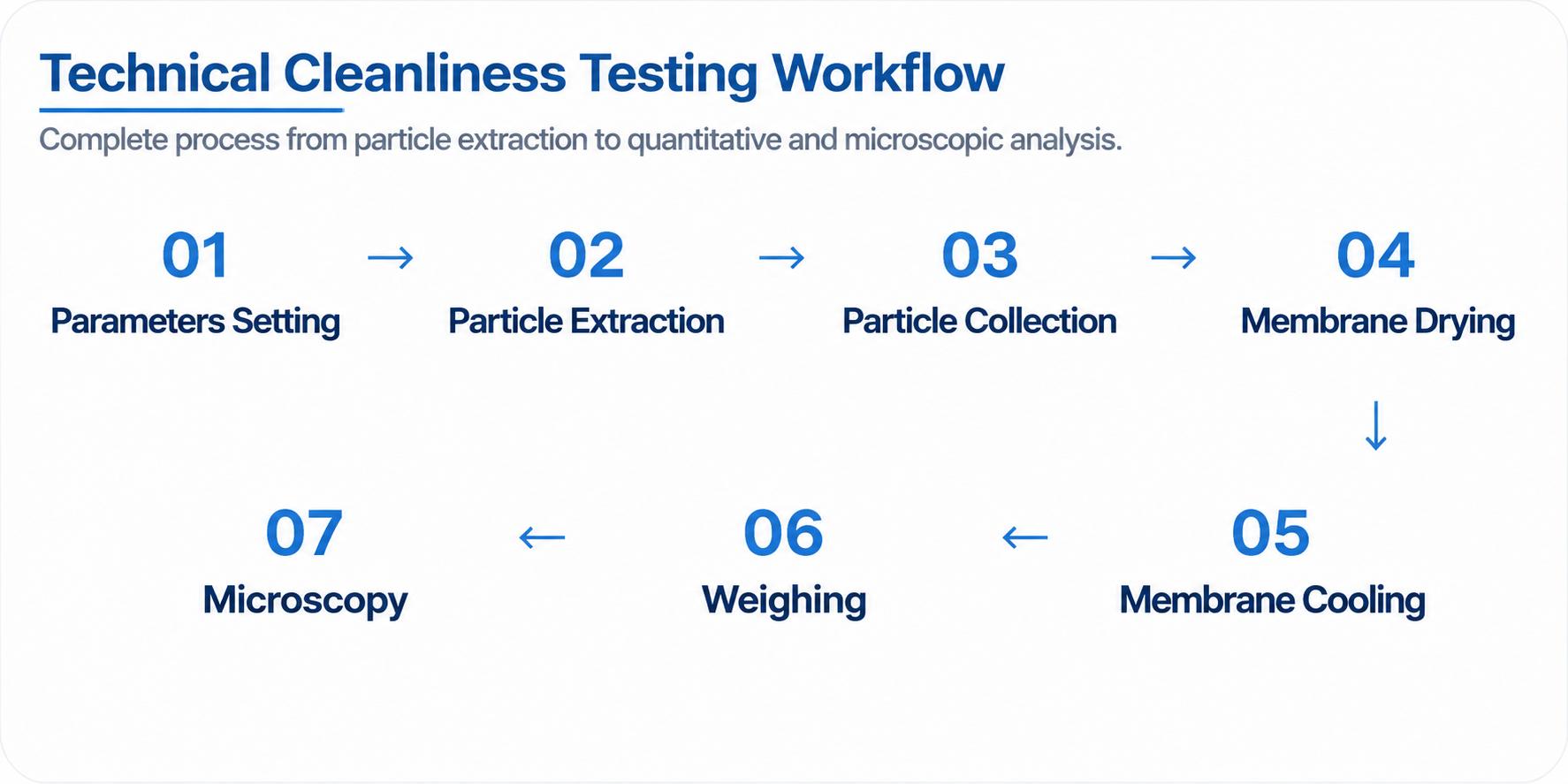
01 Parameters Setting
Set cleaning and extraction parameters according to component characteristics and inspection requirements.
02 Particle Extraction
Remove particulate contaminants from component surfaces and internal areas through controlled cleaning.
03 Particle Collection
Filter the extraction liquid to capture particulate contaminants on the membrane.
04 Membrane Drying
Dry the membrane to remove residual liquid before further analysis.
05 Membrane Cooling
Cool the dried membrane to stabilize it before weighing.
06 Gravimetric Analysis
Measure the membrane weight before and after extraction to determine the total mass of extracted contaminants.
07 Particle Analysis
Analyze particle quantity, size and morphology using a microscopic particle analysis system.
Technical Parameters
|
JC9 Component Cleanliness Cabinet
|
|
Cleaning tank size
|
Approx. 900 × 700 × 800 mm
|
|
External dimensions (W×D×H)
|
Approx. 1530 × 950 × 2000mm
|
|
Pressure range
|
0.1–5.5 bar, adjustable
|
|
Flow range
|
1–6 L/min, adjustable
|
|
Cleaning time range
|
0–9999 s, adjustable
|
|
Cleaning modes
|
Pressure cleaning; flow-rate cleaning (ultrasonic optional)
|
|
Blank value
|
Weight ≥ 0.3 mg
|
|
Cleaning agent
|
AP760 / D60
|
|
Parameter memory
|
12 sets, adjustable
|
|
Liquid filter (two-stage)
|
Max. precision pore size 0.2 μm
|
|
Storage tank
|
304 stainless steel, 24 L (customizable)
|
|
Air filtration
|
≤0.3 μm accuracy, 99.97% removal efficiency
|
|
Grating support load
|
Max. 50 kg
|
|
Working power supply
|
220 V, 2.2 kW
|
|
Base
|
Movable rollers
|
|
Total weight
|
Approx. 420 kg
|